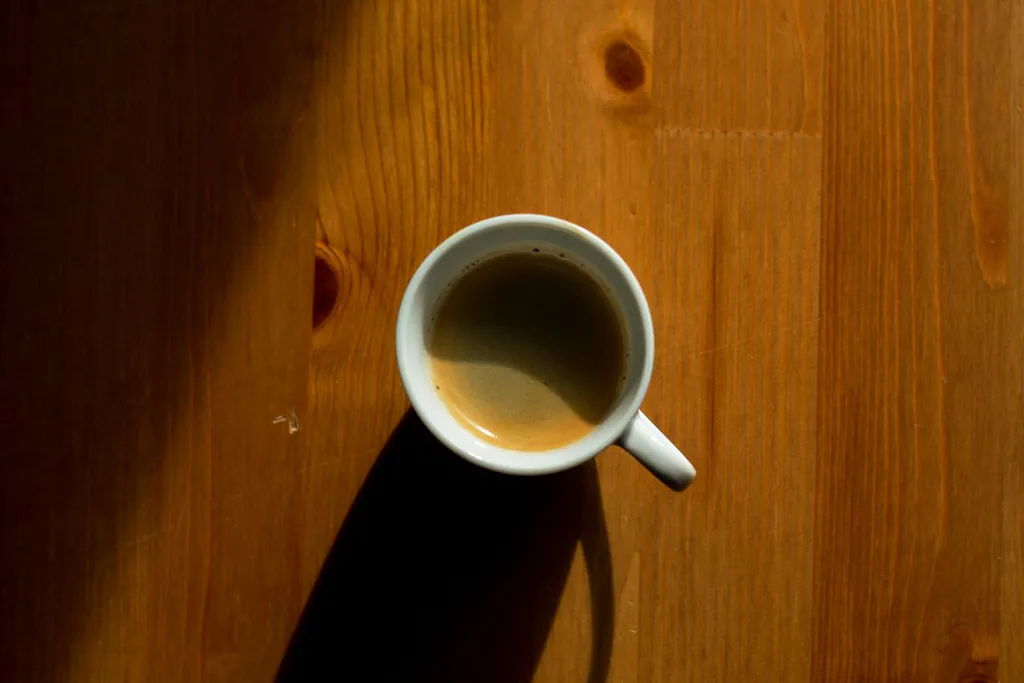
Coffee cup sizes drawn to scale
| Cup | Fluid ounces | Millilitres | Basis | Source |
|---|---|---|---|---|
| Double espresso shot | 1.4 fl oz | 40 ml | Double shot drawn as 40 ml in the drinks data (sources give 28 to 40 ml). | Seattle Coffee Gear, Coffee Bros |
| Coffee-maker "cup", brewed | 4 fl oz | 118 ml | Brewed from 5 fl oz of water (Wikipedia Cup). | Wikipedia Cup |
| NCA ratio unit (water) | 6 fl oz | 177 ml | The NCA drip guideline is 1 to 2 tablespoons per 6 fl oz of water. | NCA |
| US customary cup | 8 fl oz | 237 ml | Half a US liquid pint: 8 fl oz, about 236.6 ml. | Wikipedia Cup |
| US nutrition-label cup | 8.1 fl oz | 240 ml | Defined in US law as 240 ml. | Wikipedia Cup |
Download printable PDFOne chart, with sources and the date we checked them. No prices, no sign-up.
Link to this chart
Copy the address to share this chart (it keeps the choices you made), or save the printable PDF.
Two meanings of 'cup'
A measuring cup is a unit: half a US pint, 8 fl oz or about 236.6 ml, and 240 ml on nutrition labels. A coffee-maker cup is a marketing unit: smaller, often 5 to 6 fl oz of water. Mugs and café cups are neither; we found no source that fixes a mug size, so we do not give one.
What a '12-cup' coffee maker really holds
At 5 fl oz per maker cup, 12 cups is 60 fl oz (about 1.8 L, matching Seattle Coffee Gear's description of a 12-cup brewer). At 6 fl oz it is 72 fl oz. Brewed coffee is a little less than the water, because the grounds absorb some: Wikipedia puts 5 fl oz of water at about 4 fl oz of brewed coffee.
| Maker size | Water at 5 fl oz per cup | Water at 6 fl oz per cup |
|---|---|---|
| 4 cups | 20 fl oz (590 ml) | 24 fl oz (710 ml) |
| 8 cups | 40 fl oz (1.18 L) | 48 fl oz (1.42 L) |
| 10 cups | 50 fl oz (1.48 L) | 60 fl oz (1.77 L) |
| 12 cups | 60 fl oz (1.77 L) | 72 fl oz (2.13 L) |
Then find the coffee amount in drip coffee ratio, scoops per cup or tablespoons per cup.
Espresso and milk drink sizes
Espresso is measured in tens of millilitres, not ounces: a double shot is drawn at 40 ml in our drinks data. Milk drinks range from a 2 to 3 oz macchiato to a 10 to 12 oz latte. See the layered cups on the coffee drinks chart.
How to use the numbers: mistakes to avoid
Most brewing errors with cup sizes come from mixing the two meanings above. Check these before you measure.
| Mistake | Result | Fix |
|---|---|---|
| Putting 12 measuring cups of water in a "12-cup" maker | The tank holds far less than that, so the water and coffee amounts are wrong | Use the maker's own marks, or count maker cups at about 5 to 6 fl oz |
| Treating the "cups" on a French press or moka pot as measuring cups | The label may not match a measuring cup | Check the pot's capacity in ml or fl oz and convert |
| Assuming a mug holds a standard amount | Mugs vary and we found no source that fixes a size | Pour a mug of water into a measuring jug once and write the number down |
| Mixing ounces (weight) with fluid ounces (volume) | Dose and water are off | Use fl oz for liquid and grams for coffee; the calculator converts |
| Expecting as much coffee as water | The grounds absorb some water, so you get less in the pot | Plan for a little less brewed coffee than the water you added |
Once you know your own mug and your own maker in ml, the rest is arithmetic. The coffee ratio calculator does it for you and shows grams for each method.