Espresso accessories: what each does and when to buy
| Accessory | What it does | Need it first? | When to buy | Guide |
|---|---|---|---|---|
| Coffee scale with timer | Weighs dose and yield; times the shot | Yes | With the machine | Espresso ratio calculator |
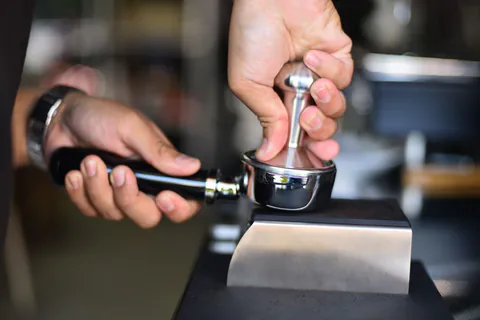
| Tamper (fit your basket) | Presses the grounds level in the basket | Yes, if the machine has none that fits | With the machine | Tamper and distributor sets |
| Distribution tool (WDT) | Breaks up clumps before tamping | No: add once you see channeling | After you can dial in | WDT and puck prep |
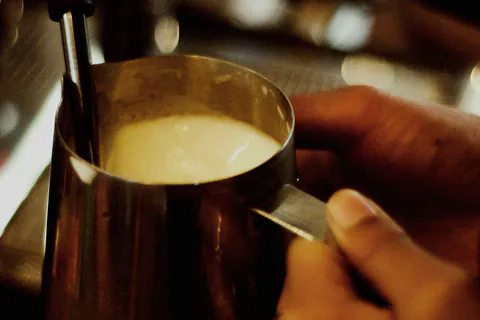
| Milk pitcher | Holds milk for steaming; a fill line helps repeat volume | Yes, for milk drinks | With the machine | Milk pitcher size |
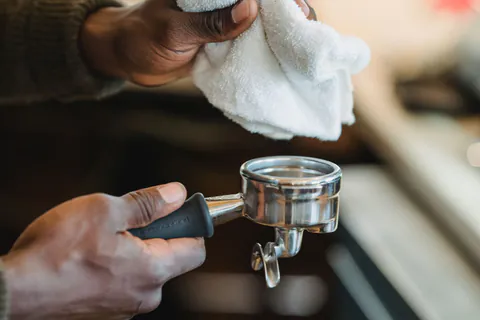
| Bottomless portafilter | Shows how the shot flows | No | When practising technique | Bottomless portafilter |
| Descaler / cleaning supplies | Removes scale and oils; use what your maker names | Yes, plan it | Before the first month | Clean and descale |
| Water filter | Reduces scale for some machines | Depends on your water | If your water is hard | Water filter guide |
| Knock box | Holds used pucks | No: a bin works | When the bin annoys you | Any espresso setup |
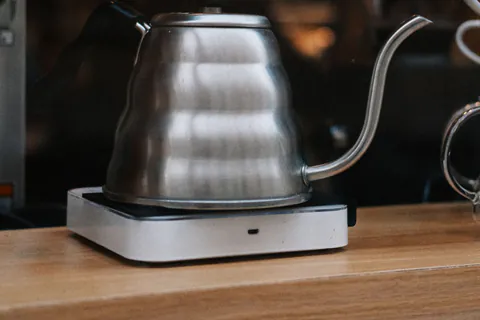
Brand picks for the scale, tamper, WDT, kettle and knock box come in later runs; today we link only the guides, and category searches on Amazon.
Check what fits before you buy
Tampers, baskets and portafilters are sized in millimetres, and they must match. Breville's BES500, BES840, BES870, BES876 and BES878 use 54 mm portafilters per the maker pages we read, and the BES920 uses 58 mm; see the portafilter size guide for the table. If you are thinking about a naked portafilter, run the compatibility check first. A bottomless portafilter shows channeling clearly; how to fix channeling explains what you will see.
Fit goes beyond size. Check how a basket is held, whether the tool's depth suits your basket and whether the maker's own parts are listed for your model. When in doubt, search the exact model name, as our buttons do.
Keep it clean: the routine that saves the most trouble
The cheapest accessory is a routine. Rinse the portafilter and basket after use, wipe the steam wand, and descale as the maker says. How often to clean the basket is covered in how often to clean a portafilter basket. Water changes everything too: water for espresso at home explains what matters. For specific machines, see descaling a Breville Barista Express, Nespresso descaling mode and Keurig descale light.
Common buying mistakes and how to fix them
Most accessory regrets come from buying before the problem is clear. These are the mistakes that come up most, and the cheaper way round each one.
| Mistake | Why it goes wrong | Do this instead | Guide |
|---|---|---|---|
| Buying a tamper by looks | Baskets are sized in millimetres; a tamper that is too small leaves a gap at the edge and one that is too big will not enter | Confirm basket size on your maker's page, then match the tamper | Tamper and distributor sets |
| Buying a kit of ten tools | Most pieces solve problems you do not have yet | Start with a scale, a fitting tamper and a pitcher, then add one tool per problem | Budget setup checklist |
| Adding a WDT before you can repeat a shot | You cannot tell what it changed if dose and grind move every day | Weigh dose and yield for a week first | WDT and puck prep |
| Going bottomless too early | A naked portafilter shows every flaw and is less forgiving, which is discouraging without a routine | Use it once you can dial in and want to read the flow | Bottomless portafilter |
| Using any cleaner that is handy | Makers name the descalers and cleaners they accept; some say not to use vinegar | Follow the manual for your model | Clean and descale |
| Ignoring water | Scale builds up faster in hard water and shortens the time between descales | Read the water guide before buying a filter | Water for espresso |
The pattern is the same each time: find the problem first, then buy the smallest thing that addresses it. If you cannot name the problem, the accessory is probably not the answer.
Which accessories for which kind of user
What counts as essential depends on how you use the machine, so here are three common situations.
The milk-drink person. If most of your cups are lattes or cappuccinos, the pitcher matters more than anything else on this page. A pitcher with a fill line lets you repeat the same amount of milk, and a thermometer or your hand tells you when to stop. Read the pitcher size guide and, if you have no steam wand, the milk frother picks.
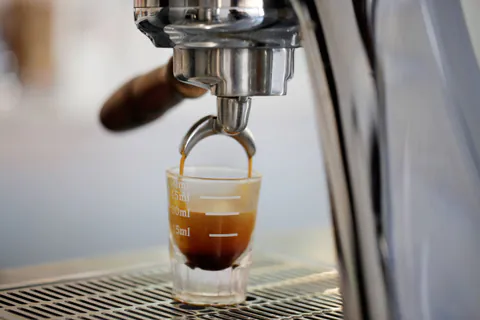
The straight-shot person. If you drink espresso on its own, taste is the whole game, and a scale with a timer pays back fastest because it turns a vague shot into numbers you can change. The espresso ratio calculator gives a target yield for your dose. Add distribution tools only if you see uneven flow.
The low-maintenance person. If you want the fewest steps, spend on cleaning supplies and a water plan rather than technique tools. A machine that is descaled on schedule keeps working; a neglected one drifts off temperature, as this troubleshooting guide describes.
Buy by the problem you have
Accessories solve specific problems. Match the symptom to the tool before you add to the cart.
| If you see... | It may be... | A tool that can help | Read |
|---|---|---|---|
| Shots that differ every time | Dose or yield not repeating | A scale with a timer | Dial in at home |
| Spurts or uneven flow | Channeling from clumps or an uneven bed | A distribution tool; level tamping | Fix channeling |
| Grounds spilling around the basket | Mess while dosing | A dosing funnel (Breville includes one with some machines, per its pages) | Puck prep |
| Milk volume that varies | No fill reference | A pitcher with a fill line | Pitcher size |
| Slow heat-up or low temperature | Scale or a settings issue | Descaling supplies from your maker | Not hot |
| Off-tasting shots with clean beans | Water or a dirty machine | A water filter, a cleaning routine | Water for espresso |
None of these makes a poor grind taste good, so check the grinder first. The grinder hub lists five we chose, with confirmed specs.
Scales, tampers and pitchers: what to check
For a scale, check that it has a timer or works with the timer you use, fits under your cup and portafilter, and reads in 0.1 g steps for espresso doses. We do not name a best scale yet; our category links search Amazon for a scale with a timer. For a tamper, match the diameter to the basket (see the portafilter size guide) and pick a base that feels level when you press. The tamper and distributor guide covers 58 mm; check your own basket size before buying a 54 mm or 51 mm model.
For a milk pitcher, size to the drink: a small pitcher is easier to steam in for one latte, and a fill line helps you repeat it. See choosing a milk pitcher size. For descaling supplies, use what your maker names and never mix descaler with vinegar or bleach; our clean and descale guide lists what the makers say and why some say no vinegar.
What to read next
Making milk drinks without a steam wand? See the best milk frother picks. If you already own a machine, the best next step is usually technique, not more gear: how to dial in, then the symptom guides on the home barista guides hub. If you are still choosing, start with the espresso machines hub and the grinders hub. The tools turn ratios into grams so the accessories you buy get used well.